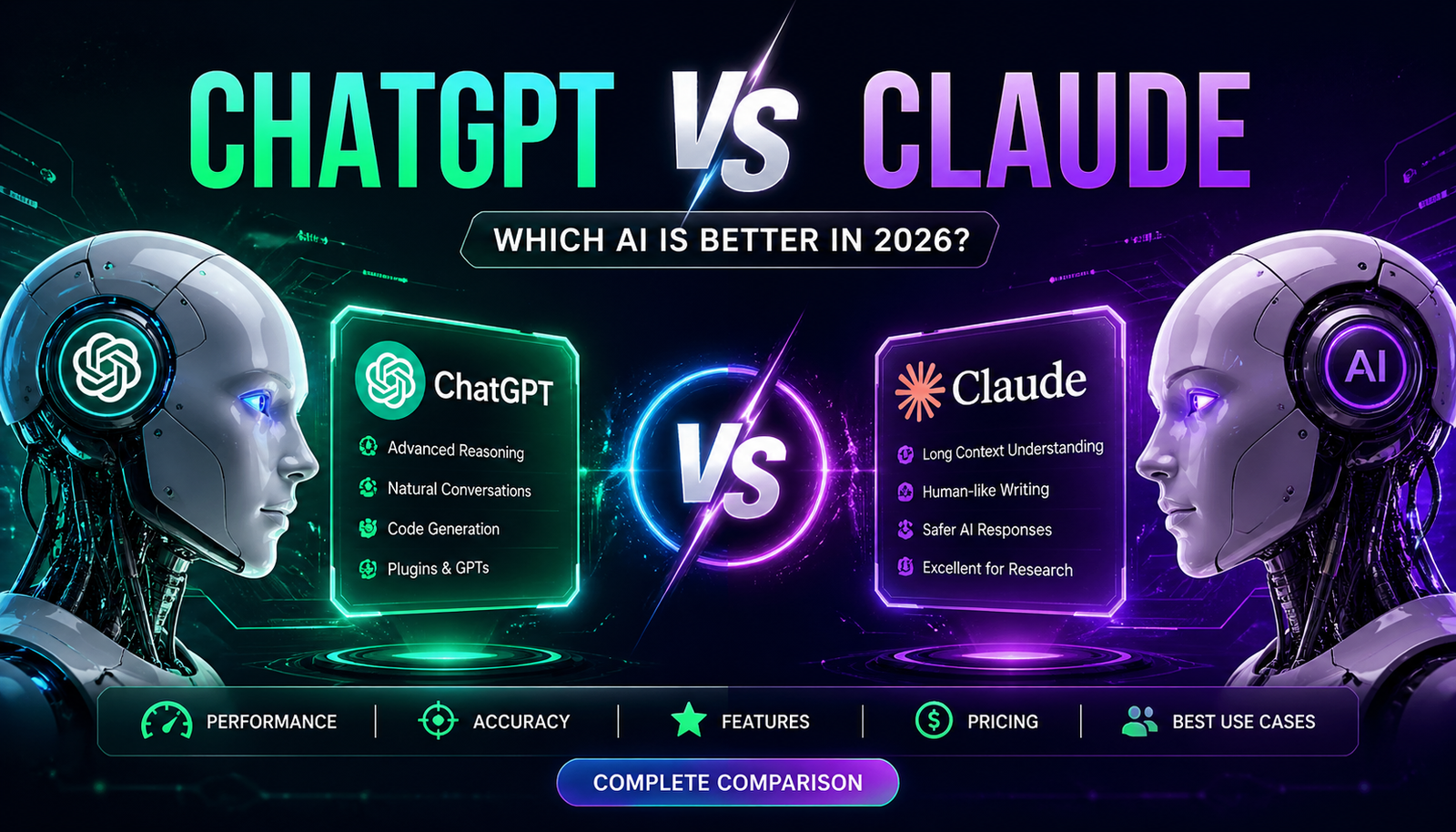
ChatGPT 5.5 vs Claude 4.7: A Direct Comparison for 2026
If you are choosing between ChatGPT 5.5 and Claude 4.7 in 2026, the decision is not straightforward. Both models have closed the gap on each other's historical weaknesses, but they still make different trade-offs in reasoning depth, output style, safety behavior, and tool integrations. This guide breaks down the real differences so you can pick the right one for your workflow.
Quick answer: ChatGPT 5.5 edges ahead for tool-heavy workflows and multimodal tasks, while Claude 4.7 is the stronger choice for long-document analysis, nuanced writing, and tasks that require careful instruction-following. Neither is universally better.
Model Overview
ChatGPT 5.5 is OpenAI's mid-cycle release sitting between GPT-5 and whatever comes next. It builds on GPT-5's reasoning backbone with improved tool use, faster response times, and tighter integration with the broader OpenAI ecosystem including DALL-E, Code Interpreter, and web browsing.
Claude 4.7 is Anthropic's latest mid-tier model in the Claude 4 family. It sits below Claude 4 Opus in raw capability but is faster and cheaper. Claude 4.7 retains the hallmarks of the Claude line: a 200K context window, strong instruction-following, and notably consistent output quality across long tasks.
Head-to-Head Comparison Table
| Feature | ChatGPT 5.5 | Claude 4.7 |
|---|---|---|
| Context Window | 128K tokens | 200K tokens |
| Multimodal Input | Text, image, audio, video | Text and image |
| Code Generation | Very strong | Very strong |
| Long Document Analysis | Good | Excellent |
| Instruction Following | Strong | Excellent |
| Built-in Web Search | Yes | Yes |
| Image Generation | Yes (DALL-E integration) | No |
| Free Tier | Yes (limited) | Yes (limited) |
| Pro Plan Price | $20/month | $20/month |
Writing Quality
Claude 4.7 consistently produces cleaner prose with fewer filler phrases. It tends to follow stylistic instructions more precisely — if you tell it to avoid passive voice or keep sentences under 20 words, it does so reliably across a 2,000-word output. ChatGPT 5.5 writes fluently but occasionally drifts from formatting constraints on longer tasks.
For creative writing, Claude 4.7 handles ambiguous or emotionally complex prompts with more subtlety. ChatGPT 5.5 is faster to generate and tends to be bolder in tone, which suits marketing copy and social content well.
If you write long-form articles, research summaries, or technical documentation, Claude 4.7 is the more reliable drafting partner. For short-form, punchy, or ad-style copy, ChatGPT 5.5 is equally capable and often quicker.
Coding and Technical Tasks
Both models perform at a high level on coding benchmarks. In practice, the gap comes down to workflow integration. ChatGPT 5.5 connects directly to Code Interpreter, lets you run Python in-session, and integrates with GitHub Copilot-style flows through the OpenAI API. That makes it the stronger choice if your work lives inside the OpenAI ecosystem or if you need to execute code, not just generate it.
Claude 4.7 is preferred by many developers for code review and refactoring tasks because its output tends to include more explanatory comments and it handles large codebases better thanks to the 200K context window. Dropping a 5,000-line file into Claude 4.7 and asking for a bug audit is a genuinely useful workflow.
Explore more AI coding tools on SwitchTools if neither model fully fits your stack.
Reasoning and Accuracy
ChatGPT 5.5 introduced improved chain-of-thought reasoning over its predecessor, with OpenAI reporting a 23% reduction in factual hallucination rates on internal benchmarks compared to GPT-5. Claude 4.7 remains competitive here, particularly on multi-step logical problems and tasks that require holding contradictory facts in context simultaneously.
For math and formal logic, the two models are close enough that workflow preference should drive the decision. For tasks involving ambiguous or incomplete information — where the model must reason about what it does not know — Claude 4.7 tends to flag uncertainty more clearly rather than confidently filling gaps.
Multimodal Capabilities
This is where ChatGPT 5.5 has a clear structural advantage. It accepts text, images, audio, and video inputs, and it can generate images via DALL-E without leaving the interface. Claude 4.7 accepts text and images but does not generate images natively and does not process audio or video.
If your workflow involves visual content creation, analyzing video transcripts, or building multimodal pipelines, ChatGPT 5.5 is the more complete tool. Claude 4.7 is competitive only on the image-reading side of that equation.
Safety and Refusals
Anthropic built Claude with a stronger emphasis on what it calls Constitutional AI — a set of trained principles that guide model behavior. In practice, Claude 4.7 refuses more edge-case requests than ChatGPT 5.5 does. Whether that is a strength or a limitation depends entirely on your use case. Researchers and developers probing edge cases may find Claude more restrictive. Users who want a consistent, predictable assistant for professional tasks will likely see it as a feature.
ChatGPT 5.5 has loosened some restrictions relative to earlier versions while still maintaining content policies. It is more permissive on hypothetical and creative scenarios.
Who This Comparison Is NOT For
If you are looking for the cheapest possible AI option, this comparison is not the right starting point. Both ChatGPT 5.5 and Claude 4.7 at full capability require paid plans, and there are capable open-source alternatives like Mistral and LLaMA that run locally for free.
If your primary need is image or video generation, neither model is the core tool — you would be better served by dedicated platforms. And if you need real-time data feeds or API integrations beyond chat, both models require additional setup that this comparison does not cover.
Pricing
Both services offer a free tier with rate limits and a Pro plan at $20 per month. At the API level, pricing differs by token volume and model tier. OpenAI's API pricing for GPT-5.5 class models is competitive with Anthropic's Claude 4.7 API, though exact rates shift frequently — check each provider's pricing page before committing to a build.
For teams, both OpenAI and Anthropic offer Team and Enterprise plans with higher rate limits, admin controls, and data privacy agreements. Claude's Enterprise plan has historically emphasized data handling transparency, which matters for regulated industries.
Which One Should You Choose?
Choose ChatGPT 5.5 if: You need multimodal input and output, you rely on image generation, you use OpenAI's broader tool ecosystem, or you want the fastest response times on short tasks.
Choose Claude 4.7 if: You work with long documents, you need precise instruction-following over extended outputs, you prioritize clean writing quality, or you want a model that handles uncertainty transparently.
Many professionals keep accounts with both and route tasks by type. That is a reasonable approach given both are at $20 per month at the Pro tier.
Frequently Asked Questions
Is Claude 4.7 better than ChatGPT 5.5 for writing?
For long-form writing that requires strict instruction-following — such as technical documentation or structured reports — Claude 4.7 tends to produce more consistent results. For short punchy copy or marketing content, both models are competitive and the difference is minor.
Does ChatGPT 5.5 have a larger context window than Claude 4.7?
No. Claude 4.7 supports a 200K token context window compared to ChatGPT 5.5's 128K. This makes Claude the better choice for tasks involving very large documents, lengthy codebases, or extended conversation history.
Can Claude 4.7 generate images?
No. Claude 4.7 can analyze and describe images but does not generate them natively. ChatGPT 5.5 integrates with DALL-E to produce images directly within the chat interface, giving it a clear advantage for visual workflows.
Which AI is more accurate and less likely to hallucinate?
Both have improved significantly in 2026, but Claude 4.7 is generally more likely to flag uncertainty rather than fabricate an answer. OpenAI reports a 23% hallucination reduction in GPT-5.5 class models. Independent benchmarks show the two are close, with task type mattering more than model brand.
What is the price difference between ChatGPT 5.5 and Claude 4.7?
At the consumer level, both are priced at $20 per month for their Pro plans. API pricing varies by token volume and model tier. Neither has a significant cost advantage at the standard Pro tier — the decision should be made on capability, not price.