🌐 English में देखें
🆓 मुफ्त
🇮🇳 हिंदी
Cebra
Cebra क्या है?
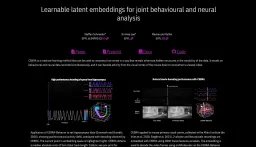
Cebra is an open-source machine learning framework for analyzing time series data by learning compressed latent representations — called embeddings — that reveal hidden structure across both behavioral observations and simultaneous neural recordings. Published in Nature in May 2023 and developed by the Mathis Lab at EPFL, Cebra operates under an Apache 2.0 license since version 0.4.0, making it freely usable for academic and most commercial research contexts. A follow-up paper on time-series attribution maps using regularized contrastive learning was accepted at AISTATS 2025.
A neuroscientist studying how a mouse's visual cortex encodes natural video faces a fundamental challenge: the raw calcium imaging or Neuropixels recordings contain thousands of simultaneous signals with no obvious mapping to the stimulus. Cebra solves this by producing consistent latent spaces across 2-photon and Neuropixels data modalities, enabling high-accuracy decoding of the viewed video directly from visual cortex activity — a capability the original paper demonstrated empirically with results that distinguish it from generic dimensionality reduction methods like PCA or UMAP.
Cebra is not suitable for general-purpose tabular data analysis, image classification, or text-based machine learning tasks — its architecture is specifically optimized for time series inputs with auxiliary behavioral or experimental variables. Non-academic commercial applications additionally require contacting the EPFL Tech Transfer Office, as a patent on the underlying dimensionality reduction method was awarded in December 2025.
A neuroscientist studying how a mouse's visual cortex encodes natural video faces a fundamental challenge: the raw calcium imaging or Neuropixels recordings contain thousands of simultaneous signals with no obvious mapping to the stimulus. Cebra solves this by producing consistent latent spaces across 2-photon and Neuropixels data modalities, enabling high-accuracy decoding of the viewed video directly from visual cortex activity — a capability the original paper demonstrated empirically with results that distinguish it from generic dimensionality reduction methods like PCA or UMAP.
Cebra is not suitable for general-purpose tabular data analysis, image classification, or text-based machine learning tasks — its architecture is specifically optimized for time series inputs with auxiliary behavioral or experimental variables. Non-academic commercial applications additionally require contacting the EPFL Tech Transfer Office, as a patent on the underlying dimensionality reduction method was awarded in December 2025.
संक्षेप में
Cebra is a free AI Tool for researchers who need to analyze high-dimensional neural time series data alongside behavioral measurements. Its peer-reviewed, Nature-published validation and cross-species compatibility — spanning calcium imaging and electrophysiology — make it the most rigorously tested open-source embedding framework for systems neuroscience.
मुख्य विशेषताएं
Advanced Latent Embeddings
Cebra applies contrastive self-supervised learning to compress high-dimensional time series into low-dimensional latent spaces that preserve the behavioral or experimental structure embedded in the data. These embeddings support both hypothesis-driven analysis — where known behavioral labels guide the embedding — and discovery-driven exploration without any labels.
Behavioral and Neural Data Analysis
The framework is specifically designed to accept paired inputs: neural recordings from calcium imaging (2-photon) or electrophysiology (Neuropixels) alongside simultaneous behavioral measurements. This pairing allows Cebra to reveal how population-level neural dynamics correlate with and encode specific behavioral states, across species including mice, rats, and non-human primates.
High-Performance Decoding
Cebra produces latent embeddings accurate enough to decode complex neural signals into meaningful outputs — including reconstructing the natural video a mouse was viewing from visual cortex recordings alone. The framework has been validated on sensory and motor tasks, in simple and complex behavioral paradigms, across single and multi-session datasets.
Flexible Application
Cebra supports both single-session and multi-session datasets, operates in label-free mode when behavioral annotations are unavailable, and works with standard Python data structures. Researchers access the official implementation via the GitHub repository maintained by the AdaptiveMotorControlLab at EPFL.
फायदे और नुकसान
✅ फायदे
- Unmatched Data Compression — Cebra's contrastive learning architecture produces latent embeddings that retain far more behavioral and task-relevant structure than PCA or UMAP when applied to neural time series, allowing researchers to extract interpretable low-dimensional representations from recordings with hundreds of simultaneously tracked neurons.
- Holistic Data Analysis — By jointly embedding behavioral and neural data into a shared latent space, Cebra enables researchers to quantify how much of the variance in neural population activity is explained by a specific behavioral variable — a question that conventional analysis approaches address only indirectly.
- High Accuracy Decoding — Cebra's latent embeddings have been independently validated for high-accuracy decoding of natural movie stimuli from visual cortex, achieving performance that distinguishes the method from existing dimensionality reduction baselines on the same datasets.
- Cross-Species Utility — The framework has been validated across mice, rats, and non-human primates using both calcium imaging and Neuropixels electrophysiology — making Cebra one of the few neural analysis tools with peer-reviewed cross-species and cross-modality generalizability.
❌ नुकसान
- Specialized Knowledge Requirement — Effective use of Cebra requires familiarity with Python, PyTorch, and the conceptual foundations of contrastive self-supervised learning — researchers without a computational neuroscience or machine learning background will encounter significant barriers to configuring experiments and interpreting embedding outputs correctly.
- Complex Setup for Novices — While the GitHub repository provides detailed documentation, configuring Cebra for specific recording types, choosing appropriate loss functions, and tuning embedding dimensions for novel datasets requires hands-on expertise that is not acquired through the documentation alone.
- Limited to Time Series Data — Cebra's architecture is optimized exclusively for sequential time series inputs with auxiliary behavioral or experimental variables — it cannot be applied to static tabular datasets, image classification tasks, or text analysis, which limits its utility to the specific domain of temporal neural and behavioral data.
विशेषज्ञ की राय
For neuroscientists mapping behavioral states to neural population dynamics, Cebra delivers peer-reviewed embedding quality that generic dimensionality reduction tools cannot match — particularly for multi-session and label-free analysis scenarios. The primary limitation is its narrow scope: Cebra is purpose-built for time series data with auxiliary variables, making it inapplicable to the majority of general ML research pipelines.
अक्सर पूछे जाने वाले सवाल
Cebra is free and open-source under an Apache 2.0 license since version 0.4.0, with the source code available on GitHub. Academic use carries no licensing cost. Non-academic commercial applications may require a licensing agreement due to a patent awarded in December 2025 — contact the EPFL Tech Transfer Office for commercial licensing terms.
Cebra accepts time series neural recordings in standard NumPy array formats, making it compatible with data exported from 2-photon calcium imaging pipelines (such as Suite2P output) and Neuropixels electrophysiology recordings (Kilosort-sorted spike trains). Behavioral variables can be provided as continuous or discrete arrays aligned to neural recording timestamps.
Unlike UMAP or PCA, which reduce dimensionality purely based on variance or nearest-neighbor geometry, Cebra uses contrastive self-supervised learning guided by auxiliary behavioral or experimental labels. This produces embeddings that specifically preserve task-relevant structure in neural population dynamics, yielding more interpretable representations for behavioral decoding than general-purpose dimensionality reduction methods.