🔒

Welcome to SwitchTools

Save your favorite AI tools, build your personal stack, and get recommendations.

Continue with Google Continue with GitHub
or
Login with Email Maybe later →
📖

Top 100 AI Tools for Business

Save 100+ hours researching. Get instant access to the best AI tools across 20+ categories.

✨ Curated by SwitchTools Team
✓ 100 Hand-Picked ✓ 100% Free ✨ Instant Delivery

Cebra

0 user reviews Verified

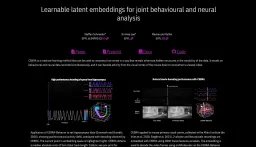
Cebra is a free open-source machine learning tool for joint behavioral and neural time series analysis, using learnable latent embeddings to decode complex neural dynamics from calcium and electrophysiology data.

Pricing Model
free
Skill Level
All Levels
Best For
Neuroscience & Life SciencesHealthcare & Medical ResearchAcademic ResearchCognitive Science
Use Cases
Neural DecodingTime Series EmbeddingBehavioral Data AnalysisHypothesis Testing
Visit Site
4.5/5
Overall Score
4+
Features
1
Pricing Plans
0
User Reviews
Updated 25 May 2026
Was this helpful?

What is Cebra?

Cebra is an open-source machine learning framework for analyzing time series data by learning compressed latent representations — called embeddings — that reveal hidden structure across both behavioral observations and simultaneous neural recordings. Published in Nature in May 2023 and developed by the Mathis Lab at EPFL, Cebra operates under an Apache 2.0 license since version 0.4.0, making it freely usable for academic and most commercial research contexts. A follow-up paper on time-series attribution maps using regularized contrastive learning was accepted at AISTATS 2025. A neuroscientist studying how a mouse's visual cortex encodes natural video faces a fundamental challenge: the raw calcium imaging or Neuropixels recordings contain thousands of simultaneous signals with no obvious mapping to the stimulus. Cebra solves this by producing consistent latent spaces across 2-photon and Neuropixels data modalities, enabling high-accuracy decoding of the viewed video directly from visual cortex activity — a capability the original paper demonstrated empirically with results that distinguish it from generic dimensionality reduction methods like PCA or UMAP. Cebra is not suitable for general-purpose tabular data analysis, image classification, or text-based machine learning tasks — its architecture is specifically optimized for time series inputs with auxiliary behavioral or experimental variables. Non-academic commercial applications additionally require contacting the EPFL Tech Transfer Office, as a patent on the underlying dimensionality reduction method was awarded in December 2025.

Cebra is a free open-source machine learning tool for joint behavioral and neural time series analysis, using learnable latent embeddings to decode complex neural dynamics from calcium and electrophysiology data.

Cebra is widely used by professionals, developers, marketers, and creators to enhance their daily work and improve efficiency.

Key Features

1
Advanced Latent Embeddings
Cebra applies contrastive self-supervised learning to compress high-dimensional time series into low-dimensional latent spaces that preserve the behavioral or experimental structure embedded in the data. These embeddings support both hypothesis-driven analysis — where known behavioral labels guide the embedding — and discovery-driven exploration without any labels.
2
Behavioral and Neural Data Analysis
The framework is specifically designed to accept paired inputs: neural recordings from calcium imaging (2-photon) or electrophysiology (Neuropixels) alongside simultaneous behavioral measurements. This pairing allows Cebra to reveal how population-level neural dynamics correlate with and encode specific behavioral states, across species including mice, rats, and non-human primates.
3
High-Performance Decoding
Cebra produces latent embeddings accurate enough to decode complex neural signals into meaningful outputs — including reconstructing the natural video a mouse was viewing from visual cortex recordings alone. The framework has been validated on sensory and motor tasks, in simple and complex behavioral paradigms, across single and multi-session datasets.
4
Flexible Application
Cebra supports both single-session and multi-session datasets, operates in label-free mode when behavioral annotations are unavailable, and works with standard Python data structures. Researchers access the official implementation via the GitHub repository maintained by the AdaptiveMotorControlLab at EPFL.

Pros & Cons

✓ Pros (4)
Unmatched Data Compression Cebra's contrastive learning architecture produces latent embeddings that retain far more behavioral and task-relevant structure than PCA or UMAP when applied to neural time series, allowing researchers to extract interpretable low-dimensional representations from recordings with hundreds of simultaneously tracked neurons.
Holistic Data Analysis By jointly embedding behavioral and neural data into a shared latent space, Cebra enables researchers to quantify how much of the variance in neural population activity is explained by a specific behavioral variable — a question that conventional analysis approaches address only indirectly.
High Accuracy Decoding Cebra's latent embeddings have been independently validated for high-accuracy decoding of natural movie stimuli from visual cortex, achieving performance that distinguishes the method from existing dimensionality reduction baselines on the same datasets.
Cross-Species Utility The framework has been validated across mice, rats, and non-human primates using both calcium imaging and Neuropixels electrophysiology — making Cebra one of the few neural analysis tools with peer-reviewed cross-species and cross-modality generalizability.
✕ Cons (3)
Specialized Knowledge Requirement Effective use of Cebra requires familiarity with Python, PyTorch, and the conceptual foundations of contrastive self-supervised learning — researchers without a computational neuroscience or machine learning background will encounter significant barriers to configuring experiments and interpreting embedding outputs correctly.
Complex Setup for Novices While the GitHub repository provides detailed documentation, configuring Cebra for specific recording types, choosing appropriate loss functions, and tuning embedding dimensions for novel datasets requires hands-on expertise that is not acquired through the documentation alone.
Limited to Time Series Data Cebra's architecture is optimized exclusively for sequential time series inputs with auxiliary behavioral or experimental variables — it cannot be applied to static tabular datasets, image classification tasks, or text analysis, which limits its utility to the specific domain of temporal neural and behavioral data.

Who Uses Cebra?

Neuroscientists
Neuroscientists use Cebra to map population-level neural activity to specific behavioral states during adaptive tasks, generating embeddings that make previously invisible neural dynamics interpretable. A systems neuroscientist studying navigation, for example, can use Cebra to reveal place-cell-like structure in cortical recordings without imposing prior assumptions about cell identity.
Behavioral Researchers
Behavioral researchers combine Cebra with kinematic tracking data to analyze how fine motor actions — grasping, locomotion, or vocalization — are represented in simultaneous neural recordings, enabling a more complete picture of the neural correlates of behavior than either dataset provides independently.
Healthcare Data Scientists
Healthcare data scientists apply Cebra to clinical time series data — including intracranial EEG recordings from epilepsy patients — to uncover latent neural states that correlate with behavioral or physiological observations, supporting next-generation diagnostic and monitoring research.
Educational Institutions
Graduate programs in computational neuroscience and systems biology use Cebra as a hands-on teaching tool, demonstrating self-supervised contrastive learning principles on real neural datasets and allowing students to reproduce published results from the Nature 2023 paper as coursework.
Uncommon Use Cases
VFX researchers exploring neural bases of visual perception use Cebra's video reconstruction capability to study how cinematic sequences are encoded in cortical activity, while BCI (brain-computer interface) developers use its decoding accuracy as a benchmark for latency-optimized neural signal classifiers.

Cebra vs MyMap AI vs GPT for Sheets and Docs vs Pabbly Connect

Detailed side-by-side comparison of Cebra with MyMap AI, GPT for Sheets and Docs, Pabbly Connect — pricing, features, pros & cons, and expert verdict.

Compare
C
Cebra
Free
Visit ↗
MyMap AI
Freemium
Visit ↗
GPT for Sheets and Docs
Freemium
Visit ↗
Pabbly Connect
Freemium
Visit ↗
💰Pricing
FreeFreemiumFreemiumFreemium
Rating
🆓Free Trial
Key Features
  • Advanced Latent Embeddings
  • Behavioral and Neural Data Analysis
  • High-Performance Decoding
  • Flexible Application
  • AI-Native
  • Multiple Format Upload
  • Web Search
  • Internet Access
  • Bulk Processing Capabilities
  • Diverse Model Selection
  • Versatile Use Cases
  • Ease of Integration
  • 2,000+ Integrations
  • No-Code Automation
  • Advanced Multi-Step Workflows
  • Cost-Effective Pricing
👍Pros
Cebra's contrastive learning architecture produces late
By jointly embedding behavioral and neural data into a
Cebra's latent embeddings have been independently valid
Converting a 30-page document or a complex topic descri
The chat-based creation model means there is no interfa
MyMap accepts source material from text, documents, URL
Running a language model prompt across an entire Google
The freemium model provides access to base AI processin
The add-on integrates as a standard Google Workspace si
Features a logical, step-by-step wizard that simplifies
The lifetime deal provides massive long-term ROI, espec
Backed by an active Facebook group of 21,000+ members a
👎Cons
Effective use of Cebra requires familiarity with Python
While the GitHub repository provides detailed documenta
Cebra's architecture is optimized exclusively for seque
The chat-based creation model is intuitive for simple d
MyMap AI requires an active internet connection for all
MyMap's AI-driven layout produces diagrams that are str
While the formula syntax is straightforward, writing ef
GPT-4 Turbo and Claude 3 model calls generate token-bas
GPT for Sheets and Docs operates exclusively within Goo
While no-code, mastering the logic of deep routers and
While it covers 2,000+ apps, some niche enterprise trig
Workflow reliability is tied to the API stability of th
🎯Best For
NeuroscientistsStudents & ResearchersContent CreatorsSmall to Medium-Sized Businesses
🏆Verdict
For neuroscientists mapping behavioral states to neural popu…
MyMap AI is the most accessible entry point for AI-generated…
For e-commerce managers, data analysts, and content teams wh…
Pabbly Connect is the 'utility player' of the automation wor…
🔗Try It
Visit Cebra ↗Visit MyMap AI ↗Visit GPT for Sheets and Docs ↗Visit Pabbly Connect ↗
🏆
Our Pick
Cebra
For neuroscientists mapping behavioral states to neural population dynamics, Cebra delivers peer-reviewed embedding qual
Try Cebra Free ↗

Cebra vs MyMap AI vs GPT for Sheets and Docs vs Pabbly Connect — Which is Better in 2026?

Choosing between Cebra, MyMap AI, GPT for Sheets and Docs, Pabbly Connect can be difficult. We compared these tools side-by-side on pricing, features, ease of use, and real user feedback.

Cebra vs MyMap AI

Cebra — Cebra is a free AI Tool for researchers who need to analyze high-dimensional neural time series data alongside behavioral measurements. Its peer-reviewed, Natur

MyMap AI — MyMap AI is an AI Tool that generates diagrams and mind maps from conversational input, uploaded files, URLs, and live web search results. Its chat-native desig

  • Cebra: Best for Neuroscientists, Behavioral Researchers, Healthcare Data Scientists, Educational Institutions, Uncom
  • MyMap AI: Best for Students & Researchers, Professionals, Content Creators, Educators, Uncommon Use Cases

Cebra vs GPT for Sheets and Docs

Cebra — Cebra is a free AI Tool for researchers who need to analyze high-dimensional neural time series data alongside behavioral measurements. Its peer-reviewed, Natur

GPT for Sheets and Docs — GPT for Sheets and Docs is an AI Tool that brings multiple AI language models into Google Sheets and Docs through a simple add-on installation, enabling bulk te

  • Cebra: Best for Neuroscientists, Behavioral Researchers, Healthcare Data Scientists, Educational Institutions, Uncom
  • GPT for Sheets and Docs: Best for Content Creators, Data Analysts, E-commerce Managers, Marketers, Uncommon Use Cases

Cebra vs Pabbly Connect

Cebra — Cebra is a free AI Tool for researchers who need to analyze high-dimensional neural time series data alongside behavioral measurements. Its peer-reviewed, Natur

Pabbly Connect — Pabbly Connect is a high-value automation engine that disrupts the market with its 'pay-once' lifetime model. By offering 2,000+ integrations and a generous pol

  • Cebra: Best for Neuroscientists, Behavioral Researchers, Healthcare Data Scientists, Educational Institutions, Uncom
  • Pabbly Connect: Best for Small to Medium-Sized Businesses, E-commerce Platforms, Marketing Agencies, Freelancers, Uncommon Us

Final Verdict

For neuroscientists mapping behavioral states to neural population dynamics, Cebra delivers peer-reviewed embedding quality that generic dimensionality reduction tools cannot match — particularly for multi-session and label-free analysis scenarios. The primary limitation is its narrow scope: Cebra is purpose-built for time series data with auxiliary variables, making it inapplicable to the majority of general ML research pipelines.

FAQs

3 questions
Is Cebra free to use?
Cebra is free and open-source under an Apache 2.0 license since version 0.4.0, with the source code available on GitHub. Academic use carries no licensing cost. Non-academic commercial applications may require a licensing agreement due to a patent awarded in December 2025 — contact the EPFL Tech Transfer Office for commercial licensing terms.
What data formats does Cebra accept?
Cebra accepts time series neural recordings in standard NumPy array formats, making it compatible with data exported from 2-photon calcium imaging pipelines (such as Suite2P output) and Neuropixels electrophysiology recordings (Kilosort-sorted spike trains). Behavioral variables can be provided as continuous or discrete arrays aligned to neural recording timestamps.
How does Cebra differ from UMAP or PCA for neural data?
Unlike UMAP or PCA, which reduce dimensionality purely based on variance or nearest-neighbor geometry, Cebra uses contrastive self-supervised learning guided by auxiliary behavioral or experimental labels. This produces embeddings that specifically preserve task-relevant structure in neural population dynamics, yielding more interpretable representations for behavioral decoding than general-purpose dimensionality reduction methods.

Expert Verdict

Expert Verdict
For neuroscientists mapping behavioral states to neural population dynamics, Cebra delivers peer-reviewed embedding quality that generic dimensionality reduction tools cannot match — particularly for multi-session and label-free analysis scenarios. The primary limitation is its narrow scope: Cebra is purpose-built for time series data with auxiliary variables, making it inapplicable to the majority of general ML research pipelines.

Summary

Cebra is a free AI Tool for researchers who need to analyze high-dimensional neural time series data alongside behavioral measurements. Its peer-reviewed, Nature-published validation and cross-species compatibility — spanning calcium imaging and electrophysiology — make it the most rigorously tested open-source embedding framework for systems neuroscience.

It is suitable for beginners as well as professionals who want to streamline their workflow and save time using advanced AI capabilities.

User Reviews

0 reviews
4.5
out of 5 · 0 reviews
5 ★
70%
4 ★
18%
3 ★
7%
2 ★
3%
1 ★
2%
✍️ Write a Review
Your Rating:
Select a rating
No account needed · Reviews are moderated before publishing
0 Reviews for Cebra

Alternatives to Cebra

6 tools
C
Rate Cebra
Share your experience
How would you rate it?